Monday, November 1, 2010

NSS, India to Launch Space-Based Solar Power Initiative

NSS, India to Launch Space-Based Solar Power Initiative

The National Space Society will hold a press conference Thursday, November 4 at the National Press Club to reveal one of the first initiatives ever undertaken by a non-profit American organization and a former head of state. That initiative pairs India’s eleventh President, Dr. A.P.J. Kalam with America’s National Space Society. Its name? The Kalam-NSS Energy Initiative.

The Kalam-NSS Energy Initiative’s goals? To solve the global energy crisis. To solve the global carbon crisis. And to solve America’s next generation jobs crisis. How? By harvesting solar power in space.

National Space Society Announces the Kalam-NSS Energy Initiative

Saturday, October 9, 2010

Join Elon Musk For an Elegant Evening at The Rocket Factory


Celebrate Freedom & Technology
at a fundraiser for
Congressman Dana Rohrabacher
Monday, October 11th
7:30 p.m.
Space Exploration Technologies
1 Rocket Road
Hawthorne, CA 90250
(Near LAX)
Catering by Wolfgang Puck
Host: $2,000 NRCC contribution
Guest: $1,000 campaign contribution
Contact: Rhonda Rohrabacher
rhonda@rohrabacher.com
714-655-9420

Saturday, September 18, 2010

Keep Space Only for Governments says the India Times

This is no joyride in The Times of India.

Manned space missions should only be carried out by agencies and professionals whose job it is to study space. It is only they who clearly understand the risks involved. Governments have a moral responsibility to protect their citizens from businesses that have no qualms about selling a potentially hazardous product.

There are several major problems with the proposition in this article. First, saying space should be left to the government is as ridiculous as saying the sea, land or air should be left to the government. Except that the area of space and the resources in space dwarf those of the sea, land and air combined.

Second, government funded space activity is big, expensive and dangerous because engineering decisions are made for political reasons. Government funded space has become a self justifying jobs program which is not required to actually produce anything and is not designed to actually do so. After 50 years of government funded manned space activity nothing has been done to actually settle and develop space. Not only do we not have Moon bases and space solar power satellites which we could have had if governments had made other choices. Humans have never even grown food in space and cooked it. What could be more basic to settlement, but no government funded manned space program has tried it. I am sure the private companies are planning to once they build permanent structures in space, since plants and animals naturally recycle carbon dioxide and other wastes produced by living humans, in recycling they naturally produce oxygen and food. With launch cost in the thousands of dollars a pound recycling in space is an obvious way to cut costs drastically. Unfortunately governments have never shown real interests in doing so since they are only interested in short term stays of small numbers of people in space.

Third, government has no moral responsibility at all. Government only have responsibility since it insists on taking our resources, government has the responsibility to use those resources for our benefit. Government should never attempt to protect citizens from themselves beyond providing information so they understand the dangers of choices.

Forth, Life without risk is not life. Many in the space movement would rather spend ten minutes in zero-gee or with their feet in Lunar or Martian soil then a millennium stuck on Earth. They have the right to spend their money to do that if they choose. It is their money and their life.

Fifth, The India Times seems unaware that the globe has a capitalist economic system. Even Castro has said communism doesn't work. To limit space to the government would assure that space would never be developed and we will never benefit from the vast resources in space.

Using the dangers and expense of government space activity caused by politicians doing engineering for political purposes such as creating jobs in the right congressional districts to justify keeping space only for governments is the most absurd proposition I have ever seen.

Friday, September 10, 2010

Don't let Pork decide NASA's future

Freeman Dyson: Congress Should Reject H.R. 5781

Freeman Dyson: Congress Should Reject H.R. 5781, Choose “Right Side of History”

The present House bill will delay the time when space can make a greater contribution to our national welfare. The most useful thing this Congress can do to lower the cost of launch is to create a market for space transportation services. The Kelly Act of 1925, which contracted for private air mail delivery, is a successful example. A consequence of the Kelly Act was the development of the DC-3. As students of history note, the commercial DC-3 ( re-designated the C-47) was an important element in winning WWII.

Tuesday, September 7, 2010

NASA Scientists Talk About Asteroids Passing Near Earth Wednesday

MEDIA ADVISORY : M10-128

NASA Scientists Talk About Asteroids Passing Near Earth Wednesday

WASHINGTON -- Two asteroids will pass within the moon's distance from Earth on Wednesday, Sept. 8. NASA scientists will be available for satellite interviews Tuesday, Sept. 7, and Wednesday morning to discuss these near- Earth objects.

The Catalina Sky Survey near Tucson, Ariz., discovered both objects on Sunday, Sept. 5. The Minor Planet Center in Cambridge, Mass., reviewed the observations and determined the preliminary orbits. The center's personnel concluded both objects would pass within the distance of the moon to Earth, approximately 240,000 miles. The asteroids should be visible with moderate-sized amateur telescopes.

Neither asteroid will hit Earth. Asteroid 2010 RX30 is estimated to be approximately 32 to 65 feet in size and will pass within approximately 154,000 miles of Earth at 5:51 a.m. EDT Wednesday. The second object, 2010 RF12, estimated to be 20 to 46 feet in size, will pass within approximately 49,000 miles at 5:12 p.m. EDT.

Saturday, September 4, 2010

Moon 2.0: Join the Revolution

Friday, September 3, 2010

An Open Letter to President Obama

An Open Letter to President Obama

Dear President Obama,

Your words are visionary but they are not being followed with action by the agencies in your administration. Three agencies in your administration are unwilling to even acknowledge a promising alternative energy source, space solar power. The concept of space solar power has been around for 40 years. Space solar power is the concept of putting large solar collectors in Earth orbit, using wireless power transmission, either microwaves or lasers, to transmit the power to customers on the Earth. This is a truly revolutionary clean source of energy which could be used to obtain nearly limitless amounts of clean, greenhouse gas free power, 24 hours a day, 7 days a week which could easily be exported. Yet space solar power has only gotten a total of $80 million of funding from the US government since the 1970's, none of it in the last decade. The Europeans and Japanese are working on space solar power. The Japanese committing $21 billion to the technology. The Russians, Chinese, and Arabs are also interested in space solar power.

In your speech on June 15, 2010 remarks to the nation on the BP oil spill: "The tragedy unfolding on our coast is the most painful and powerful reminder yet that the time to embrace a clean energy future is now. Now is the moment for this generation to embark on a national mission to unleash American innovation and seize control of our own destiny. This is not some distant vision for America. ... Scientists and researchers are discovering clean energy technologies that will someday lead to entire new industries." Yet agencies in your administration are ignoring space solar power, a concept which has only waiting for government attention and commitment to become a new vast new industry which will create millions of jobs, and bring America back to being energy independent and an energy exporter again.

In your April 15th speech at NASA's Kennedy Space Center you said "We will invest in cutting-edge research and technology. We will set far-reaching milestones and provide the resources to reach those milestones." Yet NASA is not investing in a space technology which will push the boundaries of energy technology. NASA's goal should be to become relevant to America's needs. NASA's goal should be to use space and space resources to make the United States not only energy independent, but an energy exporter again. NASA knows space solar power can do this but has chosen a different path for decades.

In your Transparency and Open Government Memorandum for the Heads of Executive Departments and Agencies, you called for the US government to become transparent, participatory and collaborative. Yet NASA, the Office of Science and Technology Policy and the Department of Energy are ignoring the results of the Open Government Ideascale. The most popular idea for all of government, for NASA, the Office of Science and Technology Policy and for the Department of Energy-."Space Solar Power Conference - Hold a conference on space solar power which brings together NASA, the Department of Energy, The Department of Commerce, University researchers as well as corporations such as Solaren, PowerSat, Space Energy, Space Island Group, Boeing etc. Also inviting the Japanese, European, Russians and Canadians who are who are working on Space Solar power. The conference would develop ideas on how best to bring this technology to reality. Space solar power offers unlimited, green, base load power. It is now time to turn this futuristic concept into reality with NASA in the lead." Despite the popularity of this idea with the public nothing is being done.

Unfortunately in the United States, Space Solar Power has a policy dilemma, The Department of Energy considers space solar power to be space not energy and NASA considers space solar power to be energy not space. Although NASA is working on biofuels which are clearly energy and not aeronautics or space and the Department of Energy has worked on nuclear power for space applications which is clearly space. The Department of Defense would like space solar power since to would greatly reduce fuel truck causalities but space solar power is definitely not in their mandate. Also the DOD is developing lasers and microwaves for military use so they can not be involved in a civilian program to develop wireless power transmission. Space Solar Power has to fall in some agencies mandate.

As President of the United States your words automatically become national policy, yet your agencies are not following your lead. You have called for the development of clean energy technologies which create new industries yet your agencies will not fund development of space solar power. You have called for agencies to push the boundaries of technology yet the Department of Energy, NASA and the Office of Science and Technology Policy are unwilling. You have called for participatory and collaborative government yet your agencies remain closed to new ideas pushed by the public despite there popularity. Mr. President, please direct you agencies to hold the interagency conference on space solar power, proclaim that one agency is responsible for developing space solar power, and direct funds for space solar power research and development, such as, an end to end systems study, lab work, flight tests and tests from the International Space Station, followed by a space solar power pilot plant able to generate power in the megawatt range. Now is the time for the United States to seize the day and develop space solar power and secure our future freedom and prosperity.


Karen Cramer Shea
Publisher
Space Solar Power Information Service

How Far Have We Fallen?

How far have we fallen in terms of exploration when NASA's Newest Exploration Analog is miners trapped in a cave? How about we explore by studying people in prison?

Thursday, August 26, 2010

Defeating the Homers, Haters and Boomers

Defeating the Homers, Haters and Boomers by Bob Werb for the Space Frontier Foundation.

A friend of ours in DC describes the opposition to the proposed NASA budget as the “homers, haters and boomers.” The homers want as much federal spending as possible in their home state or district. The haters reflexively oppose anything at all that comes out of an Administration they despise. The boomers are nostalgic for the 60s and want to recreate the imagined glories of Apollo. Some of our most vigorous opponents affiliate with two, or even three of these disjointed fellowships (as do many on the other side.)

But the real enemy of progress in civil space is a dramatically more insidious opponent that infects the body politic, an adversary so sinister and commonplace that we have come to take it for granted, the corrosive background noise of democracy. Our real enemy is apathy.

Wednesday, July 28, 2010

Jim Muncy at New Space

NewSpace 2010: NewSpace Today


NewSpace Today
Introduction to the NewSpace 2010 Conference: Where does the NewSpace industry currently stand and where is it likely to go in the future? Speaker: Jim Muncy Co-Founder, Space Frontier Foundation, President, PoliSpace

Monday, July 19, 2010

Insanity in the Senate

"Insanity: doing the same thing over and over again and expecting different results." - Albert Einstein. By this definition the Senate Commerce, Science and Space Committee is insane for pushing NASA to immediately build a Shuttle Derived Heavy Lift Launch Vehicle because it will require the use of the Solid Rocket Motors. Solid Rocket Motors cost the lives of the Challenger Astronauts.

NASA Press Conference

Sunday, July 11, 2010

Congressional Bill Calls for Commission on Planetary Defense

Congressional Bill Calls for Commission on Planetary Defense

Congressman Dana Rohrabacher (Republican from California) has introduced a bill calling for the establishment of a United States Commission on Planetary Defense. Such a group would offer guidance, among a list of tasks, on neutralizing a Near Earth Object (NEO) that may have cross-hairs on our home planet.

Space Manufacturing 14 Call for Papers

Space Manufacturing 14: Critical Technologies for Space Settlement will be held at NASA Ames Conference Center in Mountain View, CA, October 30 and 31, 2010.
Thirty five years ago, NASA Ames Research Center was the site of the first large technical study of space settlement. We have made significant progress since then, but with the prospect of low cost space transportation in the near future, now is the time to reinvigorate research and collaboration on the critical path technologies needed for space industrialization and settlement. The 14th Space Studies Institute conference on Space Manufacturing continues in the spirit of the Princeton Conferences initiated by Prof. Gerard K O’Neill in 1974.
The Space Manufacturing and Space Settlement Conferences have always given SSI great value. This conference is the only one solely concerned with the science and engineering of humanity’s expansion into the solar system. Its most important function is to bring together the engineers, entrepreneurs and researchers who do the real work. New space companies and new institutions have formed from collaborations forged at earlier conferences. We hope that this and future annual SSI conferences will be as fruitful.
The specific purpose of Space Manufacturing 14 is to identify and recommend critical hardware research that can be conducted now by SSI, NASA and other organizations.


To focus and facilitate discussion, all papers must conform to the following baseline assumptions:
Must be focused on Research and Hardware Demonstrations; Legal Session requests must be focused on Research and Scholarly Analysis.

Sessions and Preliminary Schedule are as follows:
Saturday, October 30, 2010
javascript:void(0)
Session 1: Space Transportation Architecture 
Session Chair: Gary C Hudson
9:30-11:00am

Session 2: Closed Environment Life Support Systems
Session Chair: Taber McCallum
11:00am – 12:30pm

Session 3: Robotics and Space Manufacturing
Session Chair: Professor William (Red) Whittaker
2-3:30pm

Session 4: Extraterrestrial Prospecting
Session Chair: Professor Michael F. A’Hearn
3:30-5pm

Sunday, October 31, 2010
Session 5: Engineering Materials from Non-Terrestrial Resources
Session Chair: Dr. Peter J. Schubert
9:30-11:00am

Session 6: Space Solar Power and Space Energy Systems
Session Chair: Dr. Philip K. Chapman
11:00am – 12:30pm

Session 7: International, Legal and Economic Considerations
Session Chair: James E. Dunstan, Esq.
2-3:30pm

Abstract submissions shall be:
No longer than 1000 words, and provide an outline of a presentation on research and hardware demonstrations and scholarly analysis (for legal) and a brief biography of the presenter (not to be counted as part of the 1000 word limit).
Submitted on or before August 16, 2010 by email to Colette Christiansen atabstracts2010@ssi.org, indicating for which session the paper is proposed.
Selected abstracts will be based on compliance with the baseline assumptions and likelihood to promote discussion during the sessions. Authors of selected papers will be notified by August 23, 2010.
All papers: Authors retain copyright of their works. SSI will have non exclusive publication rights for SSI; appearance release for video archives; and presentation publication rights (non exclusive to SSI). Final agenda expected to be published September 1, 2010.
Final Papers must be submitted within 14 days of the close of the conference (November 14, 2010) and shall be between 5 and 10 (electronic) pages when published. Publication guidelines will be sent to all invited and selected presenters.
For more information on abstracts, contact Colette Christiansen, Conference Director, at the submission email address (abstracts2010@ssi.org) or write to Space Manufacturing 14, Space Studies Institute, 1434 Flightline Street, Mojave, CA 93501.
Session chairs and presenters will be comped for registration (including lunch). Public registration for the conference will open in July.

Wednesday, July 7, 2010

NASA Has Been A Foreign Policy Agency For Decades

There has been a lot of recent criticism of NASA Administrator Bolden for saying one of NASA's priorities was outreach to Muslim countries, but NASA has a long history as a foreign policy agency. Apollo was nuclear war by other means. Apollo-Soyuz turned NASA from international competition to international cooperation. Which was continued by the International Space Station which used foreign policy to justify its existence. Bolden's comments are a sign of how far NASA has fallen from greatness but are not surprising.

International cooperation is incompatible with American dominance of space. American dominance of space should be NASA's main goal. Since the US proclaimed we came in peace for all mankind instead of claiming a chuck of territory around the Apollo 11 landing site, the US has been to timid to dominate space. Instead the US slunk into the safety of international cooperation.

Wednesday, June 30, 2010

Defending Planet Earth: Near-Earth Object Surveys and Hazard Mitigation Strategies: Final Report (2010) NRC

topright

Defending Planet Earth: Near-Earth Object Surveys and Hazard Mitigation Strategies: Final Report (2010) 


Summary 

The United States spends approximately four million dollars each year searching for near-Earth objects (NEOs). The objective is to detect those that may collide with Earth. The majority of this funding supports the operation of several observatories that scan the sky searching for NEOs. This, however, is insufficient in detecting the majority of NEOs that may present a tangible threat to humanity. A significantly smaller amount of funding supports ways to protect the Earth from such a potential collision or "mitigation." 
In 2005, a Congressional mandate called for NASA to detect 90 percent of NEOs with diameters of 140 meters of greater by 2020. Defending Planet Earth: Near-Earth Object Surveys and Hazard Mitigation Strategies identifies the need for detection of objects as small as 30 to 50 meters as these can be highly destructive. The book explores four main types of mitigation including civil defense, "slow push" or "pull" methods, kinetic impactors and nuclear explosions. It also asserts that responding effectively to hazards posed by NEOs requires national and international cooperation. Defending Planet Earth: Near-Earth Object Surveys and Hazard Mitigation Strategies is a useful guide for scientists, astronomers, policy makers and engineers.

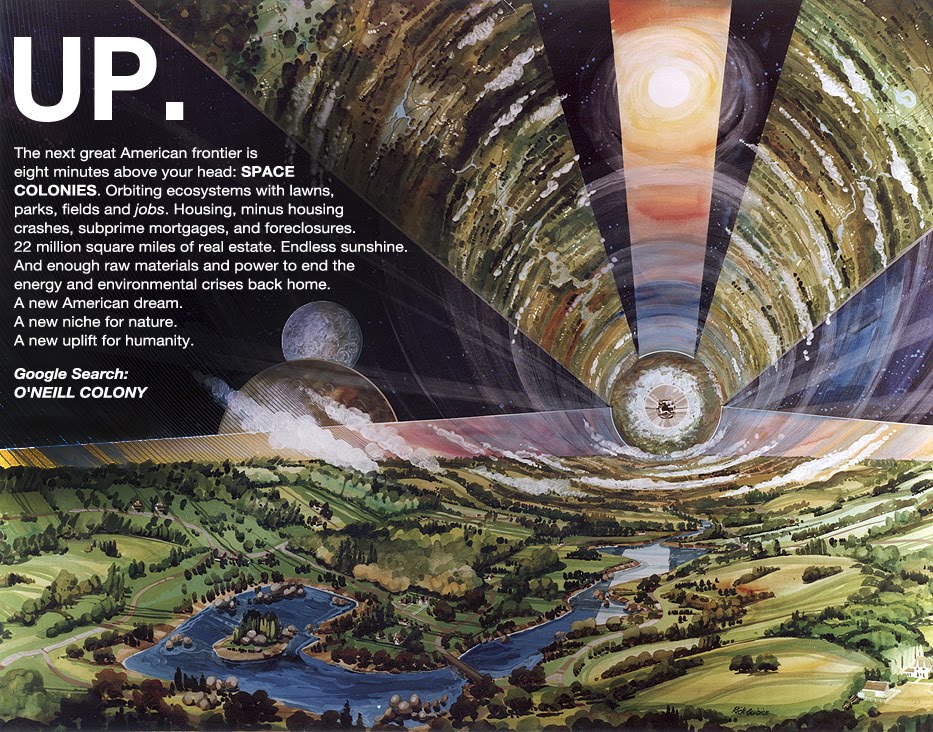
Up


For immediate release                                        

contact: JP Marin, jpmarin@howardbloom.net
Space Development Steering Committee                718 622 2278
 In the 19th century, America redefined the global economy by opening a new frontier, a new landscape of real estate, resources, and opportunities.  That American advance ended famine in Europe by giving the world the grain harvests of the Midwest.    And some of the frontier real estate that seemed wildly overpriced at 80 cents an acre in 1836 is now worth over $12 million.

In the wake of  the Great Recession of 2008,  it’s time for America to pioneer again.  This time by opening vast new landscapes not just to humanity, but to biomass, to ecosystems, and to the grand experiment of life.

In the shadow of the Chinese Century, one technology in which America continues to lead the world is access to space.  Let’s use that technology to make the next great economic leap.  Not just for ourselves, but for all humanity.

Thursday, June 24, 2010

REPLACE OIL WITH SPACE SOLAR TECHNOLOGY, SAYS S.R.I.

International, June 24, 2010 – In light of the recent oil spill in the Gulf of Mexico, The Space Renaissance Initiative (SRI) recommends that energy companies follow the courageus “Beyond Petroleum” address of a few years ago, and drill up, not down. Rather than risk further disasters as nations desperately drill for diminishing oil, SRI calls upon the leaders of the G20 to support the research and development of Space Based Solar Power (SBSP) as the energy of the future.
Rick Tumlinson, president of Space Frontier, and member of the Space Renaissance Initiative Board, says “For less than the cost of one offshore platform—and far, far less than the cost of the clean up of this disaster—we could build and operate the first tests of a space based power satellite.”
In fact, companies in Japan, Europe, and the USA have declared their intention to build a solar power station in space and beam that energy to Earth. However, the intention has not yet become realized. SRI recommends public-private partnerships between G20 governments and companies who want to grow their businesses above the atmosphere, where the Sun never sets.
“When this is accomplished, the world can access an unlimited energy supply that by-passes the need for oil; synergizing with the borning Space Tourism industry, SBSP will boost the greatest economic revolution of all times”, says Adriano Autino, President of the Space Renaissance Initiative.
Space Based Solar Power (SBSP) was first proposed by Dr Peter Glaser in 1968 and promoted in 1976 by Professor Gerard K. O'Neill of Princeton, who also proposed to use Lunar raw materials for building solar power satellites, to supply global energy markets.
SRI sees the positive benefits of SBSP and its enormous spin-off technology potentials as a gamechanging human endeavour for achieving this goal, and for transforming our earth-bound, oildependent economy into a space-faring solar economy.
About the Space Renaissance Initiative:
SRI is an international organization that has the support of 73 space-related organisations, such as: The Moon Society (USA), Next Gen Expo (USA), Centro Italiano Ricerche Aerospaziali (Italy), Advanced Technology Working Group (USA), SpaceFuture (UK, Japan), Technologies of the Frontier (Italy). SRI exists to promote the completion of the kopernican revolution: venturing out to space will assure the survival and the further growth of our civilization.
Contact:
Adriano Autino
Via Borgomasino 25/A 13040 Moncrivello (VC) Italia
+39 335 8244435
or
Peter Wainwright / Carol Pinchefsky
240 West 73rd St. #1201, New York, NY 10023 USA
+1 212 5802556

Tuesday, June 22, 2010

Open Letter To Congress On Commercial Space

Open Letter To Congress On Commercial Space


Dear Members of Congress: 

We, the undersigned space leaders, are strong supporters of human spaceflight. We are writing to urge you to both (1) fully fund the commercial crew to Space Station program proposed in the President's FY2011 budget request for NASA, and (2) accelerate the pace and funding of NASA's human space exploration projects beyond Earth orbit.

These twin pillars of human spaceflight are each crucial to the long-term health of our Nation's space program. They are also interdependent.

And they will together generate thousands of high tech U.S. jobs for people in multiple states, including Florida, Alabama, Texas, California, Nevada, Virginia, Colorado, New Mexico, and Maryland.

Among us are over 50 space leaders--former NASA executives and advisors, former astronauts, CEOs of firms large and small, a former FAA Associate Administrator, space scientists, space journalists, and others. We are a diverse group, but we are only a handful of the Nation's citizens who support U.S. leadership in human space flight in general, and the development of commercial human spaceflight in particular.

We specifically wish to express our concern that the commercial crew to Space Station program is sometimes seen as optional or too risky to America's future in space, but nothing could be further from the truth.

In fact, the commercial crew to Space Station program is a fundamental enabler of NASA's human space exploration beyond Earth orbit, specifically because it will free up the NASA dollars needed to develop deep space transportation and exploration systems for astronauts.

Moreover, a commercial crew to Station transportation system, involving multiple separate space lines as the President has proposed, is more robust than a single-legged transportation plan, whether domestic or foreign.

For these reasons and others, we fully and enthusiastically support both full funding for the commercial crew to Space Station program and also the acceleration of exploration beyond Earth orbit, as the top two priorities within NASA's human spaceflight budget.

Together, these two efforts will also:
  • Provide an affordable and fast way to close the current post-Shuttle gap in indigenous U.S. human orbital spaceflight capability, by using launch vehicles that already exist.
  • Provide a safe and robust future transportation network to low Earth orbit and beyond for U.S. astronauts. Ensure that our dependence on foreign human launch capabilities is reduced quickly and economically.
  • Reduce space access costs and enhance our national security industrial base.
  • Allow NASA to better focus on accelerating space exploration and the development of its enabling technologies.
  • Excite young Americans to careers in science, engineering, and technology.
  • Stimulate the private sector economy and the development of space commerce over in a dramatic way, by catalyzing other U.S. space interests such as space tourism and the operation of private in-space research facilities.
  • Excite entrepreneurs to envision and then give birth to new commercial services and capabilities in space, further stimulating the Nation's economy. Others have said that one of the greatest fears of any generation is not leaving things better for the young people of the next generation. We agree with this.
Therefore we reiterate that the near term development of commercial human spaceflight and a clearly defined program of human exploration beyond Earth orbit are both essential. Without either, our Nation's leadership in space will significantly suffer.

We urge you to make these two goals your highest priorities within NASA's FY2011 budget for human spaceflight.

Sincerely, 

The undersigned, listed alphabetically

Mr. Bretton Alexander
President, Commercial Spaceflight Federation
Washington, D.C.

Mr. Eric Anderson
President and CEO, Space Adventures
Vienna, Virginia

Dr. Daniel N. Baker
Director, Laboratory for Atmospheric and Space Physics, University of Colorado
Boulder, Colorado

Dr. Jim Bell
Professor, Planetary Scientist, and Member of the Mars Exploration Rover team, Cornell University
Ithaca, New York

Capt. Ken Bowersox, Ret.
Former NASA Astronaut, and Vice President of Mission Assurance & Astronaut Safety, Space Exploration Technologies Corp.
Hawthorne, California

Mr. Chad Brinkley
President, DCI Services and Consulting 
Houston, Texas

Ms. Heather Bulk
President and CEO, Special Aerospace Services
Boulder, Colorado

Mr. John Carmack
President and CEO, Armadillo Aerospace
Caddo Mills, Texas

Dr. Peter Diamandis
Chairman and CEO, X-Prize Foundation
Playa Vista, California

Mr. Frank DiBello
President and CEO, Space Florida
Kennedy Space Center, Florida

Dr. Michael Drake
Head, Lunar and Planetary Laboratory, University of Arizona
Tucson, Arizona

Mr. Art Dula
CEO, Excalibur Almaz
Houston, Texas

Ms. Esther Dyson
Principal, EDyson Ventures
New York, New York

Mr. Edward Ellegood
Director of Aerospace Development, Embry-Riddle Aeronautical University
Daytona Beach, Florida

Dr. Robert Farquhar
Senior Mission Designer, KinetX Corp.
Fairfax, Virginia

Mr. Jeff Feige
CEO, Orbital Outfitters
Los Angeles, California

Mr. Jim Foreman
President, Blue Smoke LLC
Houston, Texas

Dr. Owen Garriott
Former NASA Astronaut, and Aerospace Consultant
Huntsville, Alabama

Mr. Richard Garriott
Commercial Astronaut
Austin, Texas

Mr. Jeffrey Greason
CEO, XCOR Aerospace
Mojave, California

Dr. Jeffrey Hoffman
Former NASA Astronaut, and MIT professor
Cambridge, Massachusetts

Mr. Richard Homans
Executive Director, New Mexico Spaceport
Las Cruces, New Mexico

Dr. Scott Hubbard
Former Director of NASA Ames, and Professor
San Francisco, California

Mr. Michael Joyce
President, Next Giant Leap LLC
Boulder, Colorado

Mr. Dale Ketcham
Director, Spaceport Research & Technology Institute
Meritt Island, Florida

Mr. Jim Kennedy
Former Director, NASA Kennedy Space Center
Cocoa Beach, Florida

Mr. Glenn King
Chief Operating Officer, NASTAR; Pennsylvania
Southampton, Pennsylvania

Mr. Bill Khourie
Executive Director, Oklahoma Space Industry Development Authority, Oklahoma Spaceport
Burns Flat, Oklahoma

Dr. Byron Lichtenberg
Former NASA Astronaut
Houston, Texas

Mr. Todd Lindner
Director, Cecil Field Spaceport, Jacksonville Aviation Authority
Jacksonville, Florida

Dr. John Logsdon
Founder, Space Policy Institute, George Washington University.
Washington, D.C.

Lt. Col. J. Mike Lounge, Ret.
Former Astronaut, and President, Cisneros Innovation Strategies
Houston, Texas

Dr. Stephen Mackwell
Director, Lunar and Planetary Institute
Houston, Texas

Mr. David Masten
CEO, Masten Space Systems Inc.
Mojave, California

Mr. Bill Mitchell
CEO, Environmental Tectonics Corporation
Southampton, Pennsylvania

Mr. James A.M. Muncy
Co-Founder, Space Frontier Foundation
Alexandria, Virginia

Dr. John Muratore
Former Space Shuttle Flight Director and University of Tennessee Space Institute
Tullahoma, Tennessee

Mr. Elon Musk
CEO and CTO, Space Exploration Technologies Corp.
Hawthorne, California

Mr. Miles O'Brien
Aerospace Journalist, and Managing Editor of "This Week in Space"
New York, New York

Mr. Rich Phillips
President, Phillips & Company
Austin, Texas

Mr. Joseph E. Palaia, IV
Manager, NewSpace Center, and Vice President, 4Frontiers Corp.
New Port Richey, Florida

Mr. Brian Rishikof
CEO, Odyssey Space Research
Houston, Texas

Dr. Rusty Schweickart
Former NASA Astronaut, and Aerospace Consultant
Los Angeles, California

Col. Richard Searfoss, Ret.
Former NASA Astronaut, and Chief Test Pilot, XCOR Aerospace
Mojave, California

Mr. Frank Sietzen, Jr.
Author, and Former Editor in Chief of Ad Astra Magazine of the National Space Society
Arlington, Virginia

Mr. Mark Sirangelo
Chairman, Sierra Nevada Corporation Space Systems, and Chairman of the Board, Commercial Spaceflight Federation
Lousville, Colorado

Mr. Frederick A. Slane
Executive Director, Space Infrastructure Foundation, Inc.
Colorado Springs, Colorado

Ms. Linda Kenny Sloan
President, Information Universe
Carson, California

Ms. Patti Grace Smith
Former FAA Associate Administrator, and Aerospace Consultant
Washington, D.C.

Mr. John Spencer
Founder and President, Space Tourism Society
Los Angeles, California

Dr. Alan Stern
Former NASA Associate Administrator for Science, and Aerospace Consultant
Niwot, Colorado

Dr. Frederick A. Tarantino
President ad CEO, Universities Space Research Association
Columbia, Maryland

Mr. Rick N. Tumlinson,
Co-founder, Space Frontier Foundation
Toluca Lake, California

Col. Jim Voss, Ret.
Former NASA Astronaut, and Director of Advanced Programs, Sierra Nevada Corporation Space Systems
Louisville, Colorado

Mr. Robert W. Werb
Co-founder, Space Frontier Foundation
Nyack, New York

Mr. Stuart Witt
General Manager, Mojave Air and Space Port
Mojave, California

Drill up, not down, Mr. Obama

contact: Space Development Steering Committee
JP Marin, 718 622 2278, jpmarin@howardbloom.net


This week the president of the United States, Barack Obama, will announce a new national space policy. If the president is smart, that space policy will be an energy policy. It will focus on solar power harvested in space.

Last week, in his June 15th Oval Office BP oil spill address, President Obama called for a destiny-changing clean energy program. Says Howard Bloom, head of the Space Development Steering Committee, a group that includes Buzz Aldrin, Edgar Mitchell, and members from NASA, the National Science Foundation, and the Department of Defense, “The answer is eight minutes above Mr. Obama’s head. Space.” Says Bloom, “Solar power harvested in space means jobs, economic recovery, power to the global poor, and a new American century. Space solar power can turn America from a billion dollar a day oil importer to a net energy exporter. Space solar power can be harvested 24/7 and transmitted directly to the cities and villages that need it, from America, Europe, India, and China to the electricity-deprived corners of Africa and Asia.”

Drill up, not down, Mr. Obama. Space solar power.